Start With How the Surface Will Move
Every patio surface in Northern Colorado deals with the same underlying condition: the ground beneath it freezes, thaws, and shifts with the seasons. What differs between materials is how each one responds to that movement, and how easy it is to fix when something does shift.
Poured Concrete
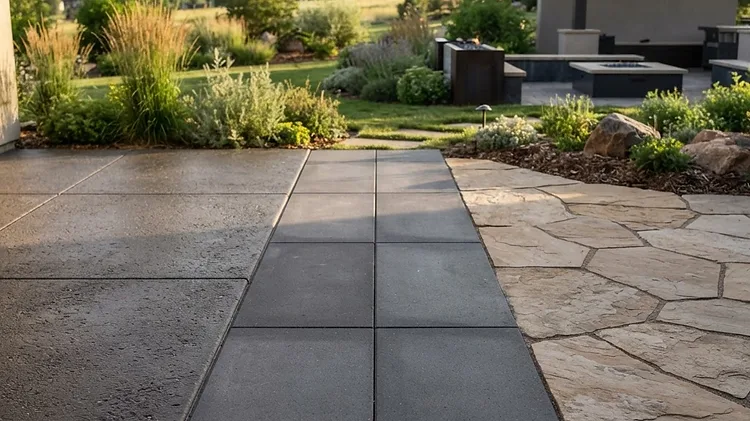
Concrete gives a clean, continuous surface and is generally the more budget-friendly option upfront. It can be stamped, stained, or scored for a more custom look. The tradeoff is that a poured slab doesn't flex. Over time, seasonal ground movement can produce cracking, usually starting at control joints, which are placed intentionally to control where that cracking happens. Repairing a cracked section typically means patching or replacing that section rather than lifting and resetting it.
Pavers
Paver systems are made of individual units set into a compacted base with sand or polymeric jointing between them. Because each paver moves somewhat independently, the system as a whole tends to handle freeze-thaw shifting without the same visible cracking concrete can show. If one area does settle or shift, that section can typically be lifted, the base corrected, and the pavers reset without redoing the whole patio. Pavers generally cost more upfront than a basic concrete pour.
Natural Stone
Natural stone, flagstone and similar materials, offers the most variation in color, texture, and pattern, since no two pieces are identical. It can be set on a compacted base similar to pavers, or in some applications on a mortar bed, which affects how it's repaired later. Natural stone sits at the higher end of the cost range, and how it performs over time depends heavily on the specific stone type and how it was installed. That's worth discussing directly with whoever is building the patio.
Jointing and Long-Term Maintenance
Concrete maintenance depends on the finish, exposure, deicing practices, staining, cracking and whether a sealer is part of the chosen system. Paver joints may need cleaning or refreshing depending on the jointing material, traffic and drainage. Natural stone maintenance depends on the stone and setting method, especially where joints, mortar or sealers are used.
Concrete, pavers, and natural stone all need some ongoing care. Ask what that actually looks like for each one: what can be cleaned, reset, or replaced locally, and what your installer or the manufacturer expects you to do over time.
Snow, Ice and Winter Use
Winter performance is partly a material question and partly a site-design question. Surface texture, slope, shaded areas, roof runoff and places where meltwater can refreeze all affect how a patio feels and functions in cold weather.
Snow-removal methods and deicing products should be compatible with the selected surface and jointing system. Product-specific guidance matters more than a blanket rule because concrete mixes, pavers, natural stones, sealers and joint materials do not all respond the same way.
Edges, Steps and Transitions Matter
A patio rarely exists as an isolated rectangle. It meets doors, walks, lawn, planting beds, steps, walls, drains and sometimes an outdoor kitchen or shade structure. Those edges can drive excavation depth, finished elevation, restraint details and drainage decisions.
Before choosing a surface from a sample, confirm how that material will finish at the house and at every major transition. A material that looks right in the field of the patio can still be a poor fit if the edge conditions create awkward steps or difficult drainage.
Repairability Is a Design Decision
Future access matters when utilities, drains, sleeves or other systems run below the patio. Individual pavers and some dry-laid stone assemblies can often be opened and reset locally. A poured or mortared system may require cutting, patching or replacing a larger area.
That does not automatically make one system better. It means future service access belongs in the material conversation when the backyard includes kitchens, lighting, irrigation, drainage or later phases.
It Really Comes Down to Budget and Upkeep
Budget usually narrows this down first, then it comes down to how much upkeep you want to take on and whether you’d rather be able to fix a small section without redoing the whole patio. All three materials can be built well or built poorly. The base underneath matters as much as what you see on top, which is why we always start there. If you want the details on why that base work matters so much, our drainage and base-prep guide gets into it.