Composite and Cedar Solve Different Problems
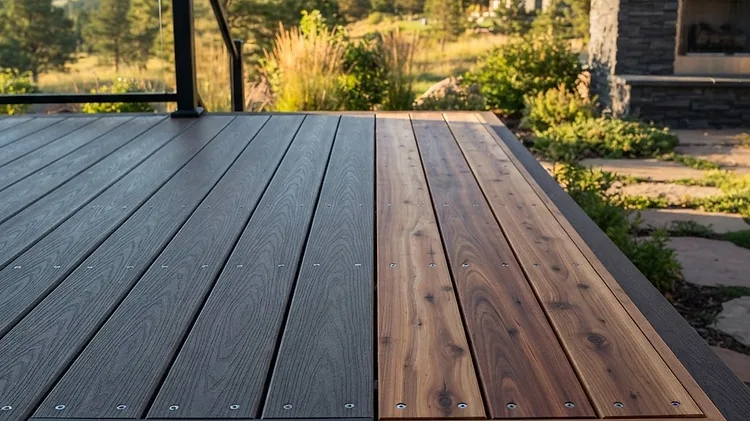
Composite and cedar solve different problems, not the same problem with different price tags. Composite appeals to people who are done with refinishing and want consistent-looking boards year after year. Cedar appeals to people who want real wood underfoot: the cooler feel, the ability to swap a single damaged board, and a surface that’s allowed to change over time.
Which one’s right for you comes down to your actual exposure, budget, how much upkeep you’re willing to do, and how you use the deck, not which category ‘wins’ on paper.
Heat and sun exposure
Any deck surface can get hot in direct sun, and color is the biggest factor in how hot, more than which material or product line you choose. A dark board absorbs more solar energy than a light one, regardless of brand. Texture, airflow, and exposure still play a role, and product lines that look similar on a small sample can feel different on a full western exposure.
View samples outside beside the house, in sun and shade. Consider children, pets, bare feet, afternoon use, and whether future shade is part of the plan. Do not choose from an indoor display alone.
What Upkeep Actually Looks Like
Cedar needs an intentional finish strategy if maintaining color is important. Exposure, surface preparation, finish type, foot traffic, and product instructions determine when cleaning or recoating is needed. Allowing cedar to weather naturally is also a design decision, not a maintenance failure, provided the assembly can drain and dry.
Most capped composite is not refinished like wood, but it still needs cleaning. Manufacturer guidance matters because approved cleaners and methods vary. Leaves, grease, snow, irrigation deposits, and debris at gaps can affect appearance and drainage.
Appearance and aging
Cedar has natural variation, knots, grain, and color movement. New repair boards may not match weathered boards immediately. Composite offers more uniformity, but embossing, sheen, repeating grain patterns, edge profiles, and fascia details vary widely.
Ask to see full boards, stair details, picture-frame borders, fascia, and railing connections, not only a six-inch color chip.
Framing and fastening still control performance
The surface does not rescue poor structure. Joist spacing, flatness, ventilation, drainage, breaker-board layout, stair framing, manufacturer-approved fasteners, and edge support all matter. Some board profiles and layouts require additional blocking or different detailing.
If an existing deck is being resurfaced, the framing should be evaluated for condition, alignment, spacing, connections, stairs, and compatibility before new boards hide it.
Repairability and future changes
Cedar can often be spot-repaired with standard woodworking methods, though matching weathered material takes care. Composite boards can also be replaced, but discontinued colors, proprietary fasteners, board profiles, and layout may affect the repair.
Accessible fastening and a deliberate board pattern improve future serviceability for either material.
Questions worth answering before selection
- How much direct sun reaches the deck during the hours you use it?
- Do you want wood to keep a finished color, or are you comfortable with natural weathering?
- How important are scratch visibility, stain resistance, and exact color consistency?
- Will the deck include stairs, curves, borders, fascia, lighting, or a future shade structure?
- What do the current installation instructions and written warranty cover?
- Can you see a built example or at least full-size boards in outdoor light?